
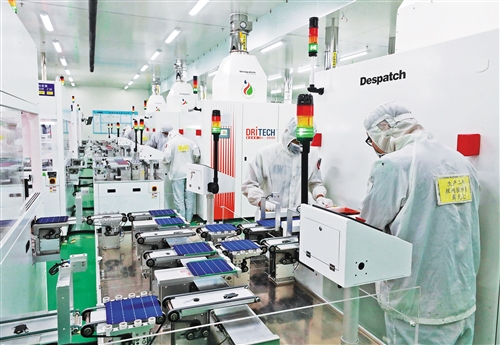
In 2017, all three major state-owned coal enterprises in Henan Province turned losses into profits. The photo shows the production line of Pingmei Longji New Energy Technology Co., Ltd. in Xiangcheng County, Henan Province, taken on October 26, 2017.
At present, China still has a relatively large coal production capacity, with prominent structural irrationality, and backward production capacity still accounting for a relatively large proportion. This year, China will strive to phase out approximately 150 million tons of coal production capacity. Meanwhile, a major adjustment will be made to the work approach for coal overcapacity reduction: shifting from overcapacity reduction focusing on total volume to systematic overcapacity reduction and structural optimization of production capacity. The key tasks include addressing "zombie enterprises", eliminating backward production capacity, vigorously removing ineffective and inefficient supply, and freeing up space for high-quality production capacity to play a better role.
Recently, the National Development and Reform Commission and other departments jointly issued the "Notice on Doing a Good Job in Resolving Excess Capacity in Key Areas in 2018". The Notice makes it clear that this year, China will strive to withdraw about 150 million tons of production capacity, ensuring that the goal of reducing about 800 million tons of production capacity achieves "substantial progress" within three years.
When interviewed by reporters from Economic Daily, relevant experts stated that shifting from overcapacity reduction focusing on total volume to systematic overcapacity reduction and structural optimization of production capacity is conducive to solving the in-depth structural problems of the coal industry. In accordance with the requirements for building a modern economic system, efforts should be made to establish a new mechanism for promoting the development of the coal industry and accelerate the realization of high-quality development of the coal industry.
Since 2016, China has completed the reduction of more than 500 million tons of coal production capacity in total. Yue Fubin, Dean of the China Coal Economic Research Institute, stated earlier that with the continuous advancement of overcapacity reduction, the operating situation of the coal industry has improved to some extent. However, not only have some long-standing issues not been fundamentally resolved, but new problems have also emerged. These problems are mainly systematic and structural, and cannot be solved simply by reducing the total volume.
Data shows that China still has a relatively large coal production capacity, with prominent structural irrationality and a relatively high proportion of backward production capacity. There are still 3,209 coal mines with an annual production capacity of less than 300,000 tons nationwide, with a total capacity of approximately 500 million tons. Among them, there are 1,954 coal mines with an annual production capacity of 90,000 tons or less, with a total capacity of 126 million tons. The task of eliminating backward production capacity and enhancing high-quality production capacity remains arduous.
The Notice further specifies the annual targets and tasks for coal overcapacity reduction, and proposes a shift from prioritizing overcapacity reduction focusing on total volume to prioritizing systematic overcapacity reduction and structural optimization of production capacity. It emphasizes key efforts such as addressing "zombie enterprises", eliminating backward production capacity, vigorously removing ineffective and inefficient supply, and freeing up space for high-quality production capacity to play a better role.
“Shifting from overcapacity reduction focusing on total volume to systematic overcapacity reduction and structural optimization of production capacity represents a major adjustment to China’s work approach for coal overcapacity reduction,” said Zhang Yousheng, Deputy Director of the Energy Research Institute under the National Development and Reform Commission. He believes that from a long-term perspective, to achieve high-quality development of the coal industry, it is essential to adopt systematic solutions to address structural issues.
“In the past two years, the coal overcapacity reduction work has mostly addressed the issue of total overcapacity, but has not effectively solved the problem of development quality,” noted Zhao Dongchen, Chief Analyst of the Raw Materials Industry at ICBC International. He pointed out that coal overcapacity reduction should not only achieve a balance between supply and demand, but more importantly, promote the structural optimization of the coal industry and realize high-quality development. The shift from overcapacity reduction focusing on total volume to systematic and structural overcapacity reduction is both feasible and necessary.
The Notice further clarifies that addressing "zombie enterprises" should be taken as a key measure, and "zombie enterprises"—which have been in long-term suspension of production and construction, suffered years of losses, become insolvent, and lack viability and development potential—should be regarded as the focus of coal overcapacity reduction in the remaining three years of the 13th Five-Year Plan period.
"To a certain extent, 'zombie enterprises' have become an 'obstacle' to the new round of structural adjustment," said Zhang Yousheng. "The existence of 'zombie enterprises' itself is a form of idle and wasteful use of resources. If these enterprises cannot be cleared as soon as possible, there will be no way to advance the structural adjustment of the coal industry."
Zhao Dongchen stated that taking the disposal of "zombie enterprises" as a key measure can effectively prevent some production capacity that has already withdrawn from the market from resurging as the industry boom picks up, which is conducive to ensuring the sustainability of the effects of overcapacity reduction policies.
Jiang Zhimin, Vice President of the China National Coal Association, stated earlier that with the accelerated pace of coal overcapacity reduction, a large number of small coal mines in southern China that fail to meet work safety standards have withdrawn from the market. Raw coal production has gradually concentrated in the Shanxi-Shaanxi-Inner Mongolia region, where resource conditions are favorable and competitiveness is strong. This shift in the regional supply pattern has posed new challenges to transportation capacity allocation and increased the pressure on coal railway transportation.
The Notice clearly states that efforts should be coordinated to carry out work such as overcapacity reduction and supply guarantee. Relevant authorities and enterprises shall, in light of adjustments to the coal production and development layout, new demand from major coal transportation corridors, and changes in (transportation) capacity, improve the railway network planning, eliminate transportation bottlenecks, and ensure the transportation demand for thermal coal in key regions.
The Notice further clarifies that the standards for coal mine capacity withdrawal in southern China should be appropriately raised, while giving greater play to the role of high-quality and advanced production capacity in northern China. This means that coal overcapacity reduction will move away from the "one-size-fits-all" approach and adopt differentiated treatment for coal mines in northern and southern China—making overcapacity reduction more scientific and helping to promote the dynamic balance between supply and demand.
"The coal resource endowment in southern China is far inferior to that in northern China. If a uniform standard were fully applied, most coal mines in southern China would have to close down. In that case, given the current transportation capacity, the pressure on coal supply in southern China would further increase," said Zhang Yousheng. He added that to achieve high-quality development of the coal industry, it is necessary to take a holistic approach, advance the work in a systematic manner, and ensure national energy security.
Zhang Yousheng also pointed out that appropriately raising the capacity withdrawal standards for coal mines in southern China does not mean allowing small coal mines to "grow unchecked". Especially as coal prices stabilize, it is even more imperative to prevent some closed small coal mines from resurging by taking advantage of this opportunity.
Zhao Dongchen, on his part, stated that since the 12th Five-Year Plan period, China has been taking the promotion of large-scale coal base construction in northern China as the main direction for adjusting the spatial layout of the coal industry, which is of great significance for advancing the intensive development of the coal industry. During the process of overcapacity reduction, continuing to give play to the role of high-quality and advanced production capacity in northern China will help optimize the industry’s spatial layout, enhance the sensitivity of domestic coal supply to changes in demand, reduce the absolute scale of production capacity, and achieve "slimming and physical fitness" of the industry.
Over the past two years, during the process of coal overcapacity reduction in China, active efforts have been made to promote the construction of advanced production capacity. A number of large-scale modern coal mines have been newly approved and constructed, the proportion of high-quality production capacity has increased significantly, and the coal capacity utilization rate has reached 68.2%, a year-on-year increase of 8.7 percentage points.
"The coal industry in China has emerged from its 'deep winter' largely due to policies, rather than the successful transformation of internal driving forces," noted Yue Fubin. He pointed out that to develop the coal industry into a modern industry that meets the requirements of market economy development, it is essential to deepen reforms, promote quality reform, efficiency reform, and driving force reform in the industry, and realize the transformation from a quantity-oriented, extensive, and externally driven model to a quality-oriented, intensive, and internally driven model.
The Notice proposes to make full use of market-oriented tools such as production capacity replacement to accelerate the development of a batch of high-quality production capacity featuring advanced technologies, high production efficiency, high resource utilization rate, strong safety support capacity, high environmental protection standards, and low energy consumption per unit of product. It also guides coal enterprises to place greater emphasis on clean, efficient, safe, and green development, and continuously improve the level of mechanization, automation, informatization, and intellectualization in coal mines. Additionally, it suggests conducting research on launching pilot projects for the transformation and development of key coal-producing regions.
“Ultimately, overcapacity reduction aims to drive the transformation, upgrading, and high-quality development of the coal industry,” said Zhang Yousheng. During this round of overcapacity reduction, a large number of enterprises with poor work safety standards and low mechanization levels will be eliminated, while a host of clean, efficient, safe, and green coal mines will stand out—thereby accelerating the transformation and upgrading of coal enterprises.
Zhao Dongchen suggested that to achieve high-quality development of the coal industry, three measures should be taken. First, promote the vertical integration of the industrial chain: encourage large enterprises to further extend their layout to downstream fields such as electric power, coal chemical industry, railways, and shipping, and strengthen the connection between coal supply and downstream demand. Second, advance the construction of coal logistics and trading networks to reduce transaction costs. Third, drive horizontal integration among large enterprises to increase the industrial concentration ratio.
At present, it is necessary to promote the in-depth integration of emerging technologies such as the Internet, big data, and artificial intelligence with the coal economy, advance the coordinated development of the coal industry with the new economy, new industries, and new business forms, and foster new growth drivers and develop new impetus," Jiang Zhimin argued. He believes that in accordance with the requirements for building a modern economic system, a new mechanism for industrial development should be established.
At the same time, it is also necessary to further advance the integration of industries such as coal-electricity integration, coal-coke integration, coal chemical industry, coal-based building materials, modern logistics, and e-commerce, so as to promote the overall upgrading of the industrial chain and enhance the industrial value chain and product added value. It is required to drive the innovation of management models, management tools, and management methods, improve the corporate governance structure, and promote management upgrading. Additionally, efforts should be made to advance the coordinated development of the supply side and the demand side, establish a production-sales integration development mechanism, and explore new models and new business forms for the coal market's supply and demand.
(Source: Xinhua Energy Network)