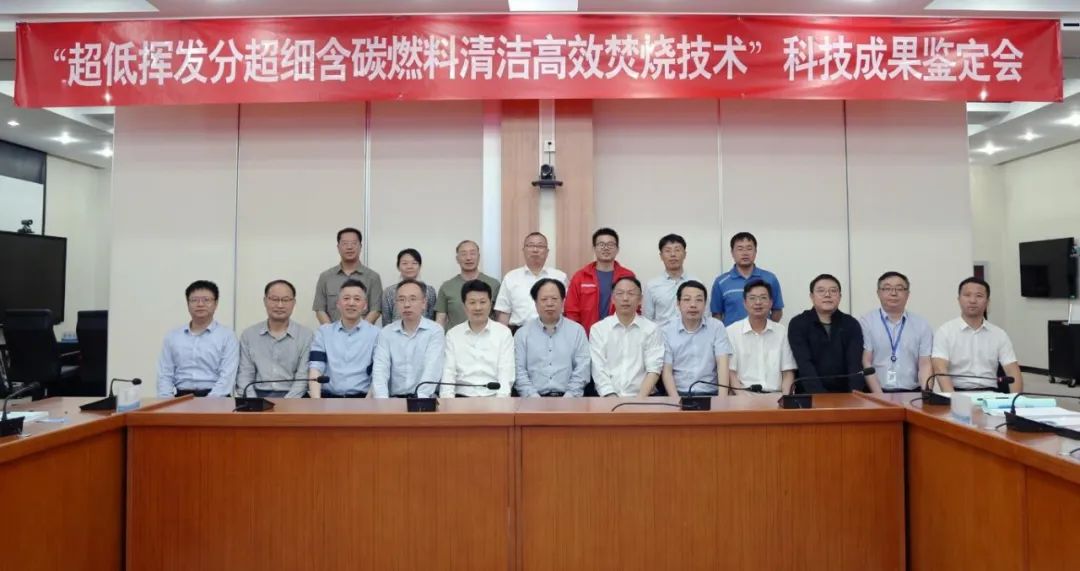

On the evening of March 28th, at just past 7 PM, Building No. 5 at the Langfang R&D Base of the Institute of Engineering Thermophysics, Chinese Academy of Sciences, was brightly lit. Experimental research on the 2-megawatt preheating combustion pilot plant had been ongoing for 36 consecutive hours. In the control room, researchers nervously stared at computer screens. "Semicoke combustion efficiency is 98.65%, and nitrogen oxide emissions are 63mg/Nm3. This is lower than the 83mg/Nm3 nitrogen oxide emissions from the previous char combustion!" As Zhu Jianguo, associate researcher from the institute's Circulating Fluidized Bed Laboratory, excitedly reported the results confirmed after repeated calculations, everyone cheered in unison.
They realized that these data meant the preheating combustion technology, which had been researched for 13 years, had achieved efficient combustion of semicoke and char, and low nitrogen oxide emissions. A key technical bottleneck that had constrained the staged utilization of low-rank coal for many years had been overcome.
How significant is the utilization value of low-rank coal? It is understood that the country's annual coal consumption is approximately 4 billion tons, with low-rank coal accounting for about 50%. If all this low-rank coal were pyrolyzed, about 10% tar could be extracted, equivalent to an annual increase of 200 million tons of oil, which could replace about 50% of imported crude oil. In addition, low-rank coal can be gasified to produce industrial gas or synthesis gas and natural gas. However, along with the oil and gas, 1 billion tons of semicoke and char are also produced. As the oil and gas have been extracted from this portion of semicoke and char, their volatile matter content is often below 10% or even 5%, making ignition and complete combustion extremely difficult, and achieving low-emission combustion seems almost impossible.
The staged utilization of low-rank coal is of great significance but also poses high difficulties, daunting many researchers. How to process semicoke and char with volatile matter below 5% is not only a key technical bottleneck in the country's low-rank coal staged utilization but also a global challenge. "Initially, we also followed the most cutting-edge ideas both domestically and internationally, which was to use high-temperature air combustion technology, heating the air first, and then adding coal for combustion," said Lu Qinggang. "However, we found that this method was ineffective for particularly difficult-to-burn coal because air not only has a very small heat capacity but also carries away part of the heat due to flow."
It is understood that the earliest high-temperature air combustion technology originated from the steel industry. High-temperature air preheating is widely used in steel billet heating processes. However, when this technology is applied to the coal industry, due to differences in the heating medium, especially with flue gas containing particles and fine ash, regenerative air heat exchangers are prone to clogging, making practical application impossible. "When we exchanged ideas with counterparts in Germany and Japan in related fields, we found that their current experiments had not achieved success," said Lu Qinggang.
How to overcome difficulties? How to achieve stable combustion and clean emissions of low-volatility fuels? Breaking through requires a different approach. Lu Qinggang's thinking returned to the three basic elements of combustion: combustible material, oxygen, and temperature. "What if we don't heat the air first, but instead heat the fuel?" This sudden idea excited Lu Qinggang. "Generally, the ignition point of coke is 700℃. If we first heat the fuel to 800℃ to 900℃, and then introduce air, it can combust directly, and there won't be any stability issues."
Based on this, in 2004, the Circulating Fluidized Bed Laboratory at the Institute of Engineering Thermophysics, Chinese Academy of Sciences, where Lu Qinggang works, was the first to propose the concept of fuel preheating combustion, and subsequently applied for and was granted a patent for invention. This represents a significant shift in combustion methods, theoretically breaking through conventional heating, ignition, and combustion approaches, allowing pulverized coal to be preheated in the combustor to a temperature above its ignition point, and enabling efficient and clean combustion of the preheated fuel in the furnace.
"Existing domestic heating methods like plasma arc and microwave are very power-intensive and too costly," said Lu Qinggang. "We proposed a low-cost idea: allowing the fuel to burn a small portion of itself (5% to 10%) to heat itself. When the heat absorption of the coal balances the heat released by combustion, stable heating is achieved." From 2004 to 2012, with funding from the National Natural Science Foundation of China and the Director's Fund, the laboratory built a 30-kilowatt preheating combustion experimental platform, and conducted mechanistic experimental research, mastering the preheating mechanism of pulverized coal, the combustion mechanism of preheated fuel, and the migration and transformation laws of coal nitrogen. From 2013 to the present, with funding from the Chinese Academy of Sciences' Strategic Priority Research Program "Key Technologies and Demonstration for Clean and Efficient Cascaded Utilization of Low-Rank Coal," the laboratory intensified its R&D efforts in preheating combustion pilot tests, scale-up, and engineering demonstrations, successively constructing 0.2 MW, 0.4 MW, and 2 MW preheating combustion experimental platforms at its Langfang R&D base.
Previously, coal utilization involved pollution first, then treatment. After combustion of difficult-to-ignite coal types, nitrogen oxide (NOx) emissions reached 600 mg/Nm3 to 1000 mg/Nm3, requiring additional tail-end denitrification devices for treatment, yet even after treatment, ultra-low emissions could not be achieved. With the adoption of the preheating combustion method, the reactivity of pulverized coal improved, enabling uniform and complete combustion within the furnace, thus significantly reducing the initial formation of nitrogen oxides.
In March this year, multiple experiments conducted using semi-coke and char as fuel showed NOx emissions below 100 mg/Nm3, signifying the pilot-scale success of the preheating combustion technology. "This gave us peace of mind," said Lu Qinggang. "Based on existing experience, transitioning from pilot-scale to industrial-scale experiments will still require one to two years." From the theoretical proposal in 2004 to the pilot-scale success in March this year, 13 years have passed. From 30 kilowatts, to 0.2 megawatts, to 0.4 megawatts, to 2 megawatts, and then to a future 14 megawatts, the research achievements are steadily moving towards industrial application.
From an initial idea by one person, to experiments by two, and now a core technical team of about ten people, the research strength in the field of preheating combustion is gradually expanding. Lu Qinggang told reporters that the demonstration project is planned to be finalized and implemented by the end of this year or early next year. Currently, matters such as user adoption and boiler equipment manufacturing are under negotiation.
In the industry, the goal is to achieve ultra-low emissions, and research into the underlying mechanisms has not ceased. "Currently, nitrogen oxide emissions are below 100 mg/Nm3, and in the future, we aim to reduce them to below 50 mg/Nm3, eliminating the need for tail-end denitrification devices, thereby directly achieving ultra-low emissions and making coal a clean energy source," said Lü Qinggang. "This might take 5 years, or even longer."
According to reports, preheating combustion technology has overcome the mutual constraint between efficient fuel combustion and low nitrogen oxide emissions. Once it enters the market, its prospects will be extremely broad. On one hand, it can be used for the combustion and utilization of ultra-low volatile fuels produced by the graded conversion of low-rank coal. The semi-coke yield from low-rank coal pyrolysis is around 50% of the raw coal, and the residual carbon yield from gasification is around 20% of the raw coal. With the development of China's low-rank coal graded conversion industry, coal pyrolysis, gasification, coking, and other industries will produce hundreds of millions of tons of semi-coke and residual carbon annually. Preheating combustion technology can fully utilize these ultra-low volatile fuels, which were previously difficult to treat and utilize. On the other hand, it can be used for the combustion and utilization of low-volatile coals such as anthracite, significantly reducing nitrogen oxide emissions. Moreover, this preheating combustion boiler can also be used for the combustion of conventional coal types, with no specific requirements for coal type.
"This is currently the largest market. China has over 500,000 industrial coal-fired boilers, consuming over 600 million tons of coal annually. 70% of these coal-fired boilers are chain grates, with an average efficiency of only 65%, and pollutant emissions exceed standards and are difficult to supervise," said Lü Qinggang. "Once our technology is put into use, it can replace existing outdated equipment, providing technical products with high combustion efficiency and low pollutant emissions, with a market capacity exceeding one hundred billion yuan."